
Vietnam’s Free Trade Agreements
Vietnam’s accession to the World Trade Organization (WTO) in 2007 marked its ascension as a committed and robust trade partner for the global community. Since then, the country has entered into numerous Free Trade Agreements and Double Tax Avoidance Agreements.
A Free Trade Agreement (FTAs) is a type of agreement utilized by two or more countries in order to agree on the terms of trade between them. Such agreements determine the value of tariffs and duties that countries impose on imports and exports.
List of Vietnam’s Free Trade Agreements
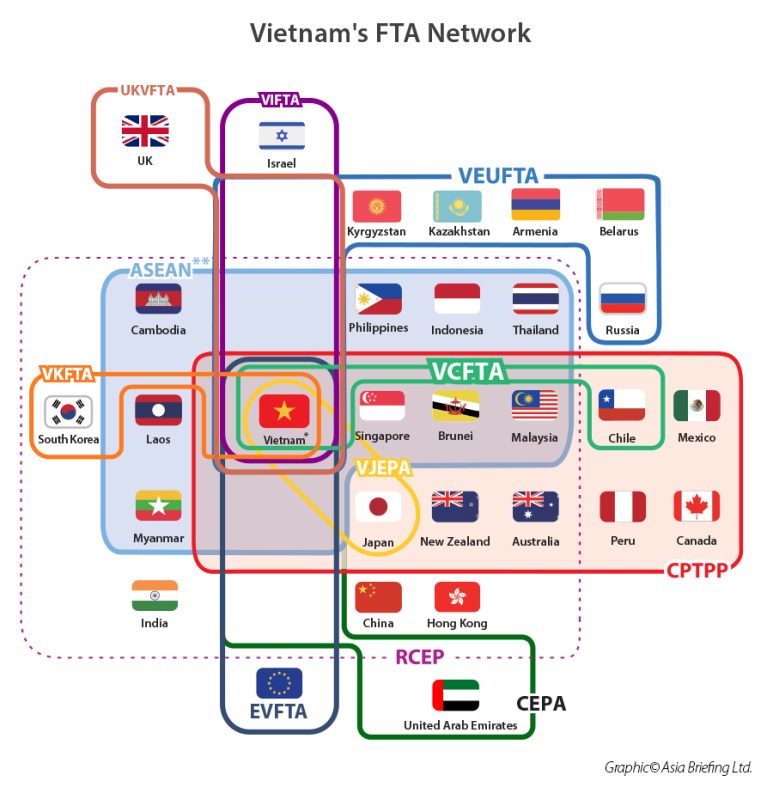
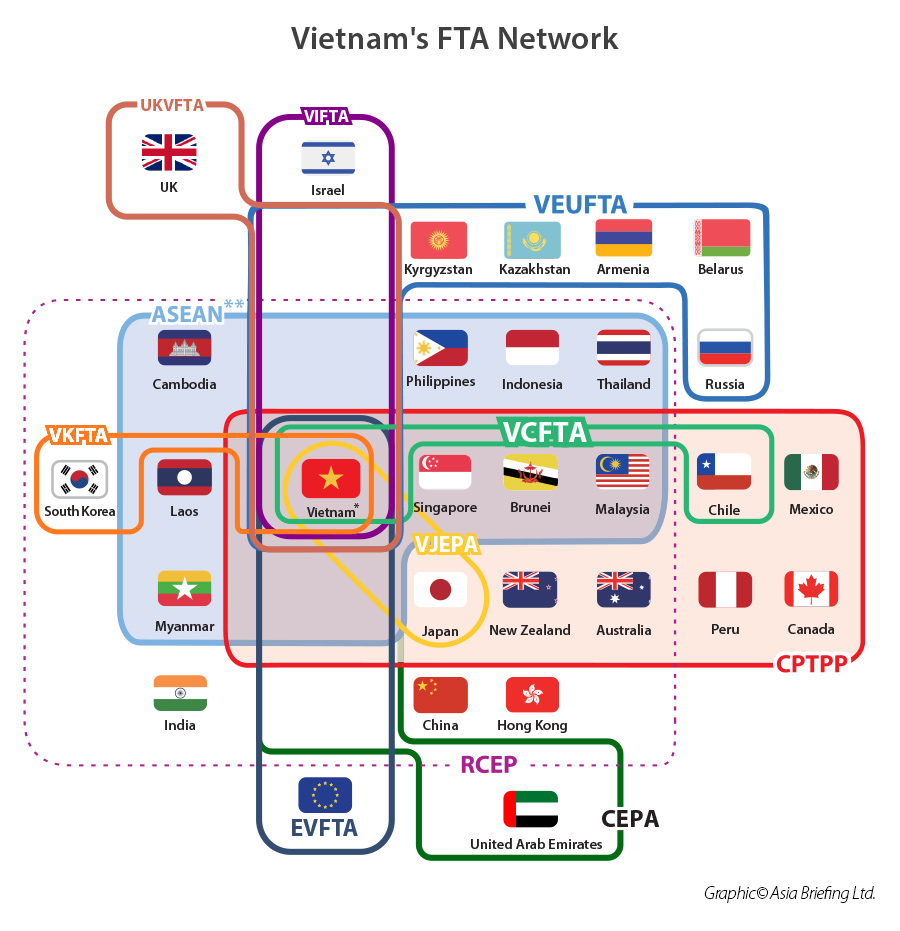
In all, Vietnam is a signatory to 18 active and planned, bilateral and multilateral Free Trade Agreements. These offer direct potential trade advantages with numerous partner countries and regions as listed below:
Free Trade Agreement
Abbreviation
Signatories
Effective date
ASEAN Free Trade Area
ASEAN
ASEAN Member States:
- Brunei;
- Malaysia;
- the Philippines;
- Singapore;
- Thailand;
- Cambodia;
- Laos;
- Myanmar;
- Indonesia; and,
- Vietnam
1993
ASEAN-China Comprehensive Economic Cooperation Agreement
ACFTA
- ASEAN Member States
- China
2005
ASEAN-South Korea Comprehensive Economic Cooperation Agreement
AKFTA
- ASEAN Member States
- Korea
2007
ASEAN-Japan Comprehensive Economic Partnership
AJCEP
- ASEAN Member States
- Japan
2008
Japan-Vietnam Economic Partnership Agreement
VJEPA
- Japan
- Vietnam
2009
ASEAN-India Comprehensive Economic Cooperation Agreement
AIFTA
- ASEAN Member States
- India
2010
ASEAN-Australia and New Zealand Free Trade Agreement
AANZFTA
- ASEAN Member States
- Australia
- New Zealand
2010
Vietnam-Chile Free Trade Agreement
CVFTA
- Chile
- Vietnam
2012
South Korea-Vietnam Free Trade Agreement
VKFTA
- South Korea
- Vietnam
2015
Eurasian Economic Union-Vietnam Free Trade Agreement
VEAEU
- Belarus
- Kazakhstan
- Armenia
- Kyrgyz Republic
- Vietnam
2016
Comprehensive and Progressive Agreement for Trans-Pacific Partnership
CPTPP
- Australia
- Canada
- Japan
- Mexico
- New Zealand
- Singapore
- Vietnam
- Peru
- Brunei (signed but has yet to ratify)
- Chile (signed but has yet to ratify)
- Malaysia
2019
ASEAN-Hong Kong, China Free Trade Agreement
AHKFTA
- ASEAN Member States
- Hong Kong
2019
EU-Vietnam Free Trade Agreement
EVFTA
- EU Member States (27 countries)
- Vietnam
2020
United Kingdom – Vietnam
CEPA
- United Kingdom
- Vietnam
2025
Regional Comprehensive Economic Partnership
RCEP
- ASEAN Member States
- Australia
- Japan
- China
- New Zealand
- South Korea
2022
Vietnam – Israel Free Trade Agreement
VFITA
Vietnam, Israel
2023
Vietnam – UAE Comprehensive Economic Partnership Agreement
Vietnam – UAE FTA
Vietnam, United Arab Emirates (UAE)
2024
Planned Free Trade Agreements
Vietnam is negotiating future potential agreements with Israel (Vietnam-Israel FTA) and the European Free Trade Association comprised of Switzerland, Norway, Iceland, and Liechtenstein (Vietnam-EFTA). Vietnam is also actively involved in the ongoing FTA negotiations between ASEAN and Canada.
The effects of Free Trade Agreements in Vietnam
Free Trade Agreement advantages
Beyond the obvious benefits of helping to increase trade with other countries and making it a more attractive investment destination for exporters and importers, there are a number of strategic benefits towards Vietnam’s development as well.
Free trade agreements will enable Vietnam’s economic development to continue to shift away from exporting low-tech manufacturing products and primary goods to more complex high-tech goods like electronics, machinery, vehicles and medical devices.
This can occur first, by the country boosting its export competitiveness by diversifying its sourcing partners through larger trade networks and cheaper imports of intermediate goods from partner countries. For example, recent trade agreements like the RCEP and EVFTA extend Vietnam’s trade integration partners well beyond Asia, allowing Vietnam to take advantage of the reduced tariffs, both within the ASEAN Economic Community (AEC) and with the EU and US to attract exporting companies to produce in Vietnam and export to partners outside ASEAN.
Second – through partnership with foreign firms that can transfer the knowledge and technology needed to make the jump into higher value-added production. An example of this is the Vinfast electric automobiles manufactured by Vietnamese conglomerate Vingroup. While Vietnam is touted as a low-cost manufacturer, the pioneer player Vingroup has cooperated with global MNCs such as Intel (USA), LG (South Korea) and Contemporary Amperex Technology Company (China) to produce components for e-cars. Vinfast’s gains represent how Vietnam can develop its own products from the transfer of know-how and technology. Such sophisticated business practices and technology will help boost Vietnamese labor productivity and expand the country’s export capacity.
Vietnam’s entry into these trade deals will also ensure alignment with national standards ranging from employee rights to environmental protection. Both the CPTPP and EVFTA require Vietnam to conform to the International Labor Organization’s (ILO) standards. The ILO has noted that this is an opportunity for Vietnam to modernize its labor laws and industrial relations systems. The standard of product quality, manufacturing, and employee rights guaranteed in these agreements will allow Vietnam to become a manufacturing hub and expand as an exporting base.
Free Trade Agreement challenges
FTAs are known to come with potential downsides like the possible triggering of aggressive competition from foreign rivals upon local businesses. In Vietnam, an example area of this type of concern is within the meat and dairy products agriculture sector, which reportedly faces strong competition from products imported by EU, Australia, and Canada-based companies. To address such challenges, local firms in Vietnam must adapt and make use of new market opportunities as well as potential partnerships with foreign firms to remain competitive in the global and local market.
Double Tax Avoidance Agreements
Double Tax Avoidance Agreements treaties effectively eliminate double taxation by identifying exemptions or reducing the amount of taxes payable in Vietnam.
Global investors often find themselves in an unfavorable position of having to face being double taxed – taxed by two different countries on the same income – unless there is a double tax avoidance agreement in places. For example, a company might be subject to taxes in its country of residence and also in the countries where it raises income through foreign investments for the provision of goods and services.
It is therefore extremely worthwhile for foreign investors to be aware of which double taxation avoidance agreements (DTAAs) between Vietnam and other countries might be applicable to their situation, as well as understand how these agreements are applied.
As of 2024, Vietnam has signed DTAs with 80 countries and territories, including France, China, and Canada. These treaties eliminate double taxation by identifying exemptions or reducing tax payable in Vietnam for residents of the signatories of the agreements.