
Sin(a + b) is one of the important trigonometric identities used in trigonometry. It is one of sum and difference formulas. It says sin (a + b) = sin a cos b + cos a sin b.
We use the sin(a + b) identity to find the value of the sine trigonometric function for the sum of angles. The expansion of sin a plus b formula helps in representing the sine of a compound angle in terms of sine and cosine trigonometric functions. Let us understand the sin(a+b) identity and its proof in detail in the following sections.
1. What is Sin(a + b)? 2. Proof of Sin(a + b) Formula 3. How to Apply Sin(a + b)? 4. FAQs on Sin(a + b)
Sin(a + b) is the trigonometry identity for compound angles. It is applied when the angle for which the value of the sine function is to be calculated is given in the form of the sum of angles. The angle (a + b) represents the compound angle.
Sin(a + b) Compound Angle Formula
Sin(a + b) formula is generally referred to as one of the addition formulas in trigonometry. The sin a plus b formula for the compound angle (a + b) can be given as,
sin (a + b) = sin a cos b + cos a sin b
The proof of expansion of sin(a + b) formula can be done geometrically. Let us see the stepwise derivation of the formula for the sine trigonometric function of the sum of two angles. In the geometrical proof of sin(a + b) formula, let us initially assume that ‘a’, ‘b’, and (a + b) are positive acute angles, such that (a + b) < 90. But this formula, in general, is true for any positive or negative value of a and b.
To prove: sin (a + b) = sin a cos b + cos a sin b
Construction: Assume a rotating line OX and let us rotate it about O in the anti-clockwise direction. OX makes out an acute ∠XOY = a, from starting position to its initial position. Again, the rotating line rotates further in the same direction and starting from the position OY, thus making out an acute angle given as, ∠YOZ = b. ∠XOZ = a + b < 90°.
On the bounding line of the compound angle (a + b) take a point P on OZ, and draw PQ and PR perpendiculars to OX and OY respectively. Again, from R draw perpendiculars RS and RT upon OX and PQ respectively.
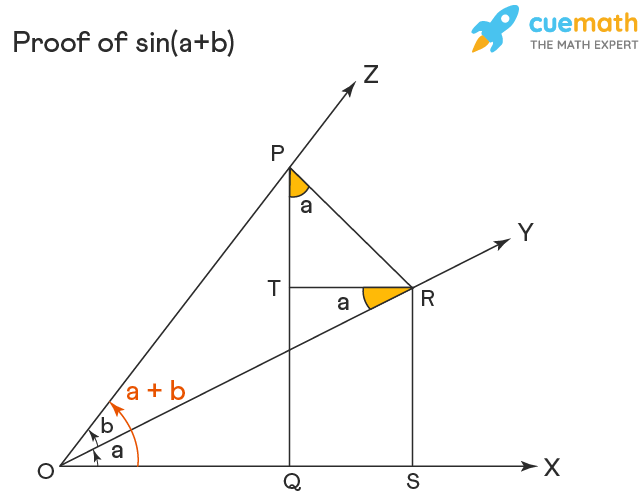
Proof: From triangle PTR we get, ∠TPR = 90° – ∠PRT = ∠TRO = alternate ∠ROX = a.
Now, from the right-angled triangle PQO we get, sin (a + b) = PQ/OP = (PT + TQ)/OP = PT/OP + TQ/OP = PT/OP + RS/OP = PT/PR ∙ PR/OP + RS/OR ∙ OR/OP = cos (∠TPR) sin b + sin a cos b = sin a cos b + cos a sin b, (since we know, ∠TPR = a)
Therefore, sin (a + b) = sin a cos b + cos a sin b.
The expansion of sin(a + b) can be used to find the value of the sine trigonometric function for angles that can be represented as the sum of standard angles in trigonometry. We can follow the steps given below to learn to apply sina plus b identity. Let us evaluate sin(30º + 60º) to understand this better.
- Step 1: Compare the sin(a + b) expression with the given expression to identify the angles ‘a’ and ‘b’. Here, a = 30º and b = 60º.
- Step 2: We know, sin (a + b) = sin a cos b + cos a sin b. ⇒ sin(30º + 60º) = sin 30ºcos 60º + sin 60ºcos 30º From trig table, sin 60º = √3/2 , sin 30º = 1/2, cos 60º = 1/2, cos 30º = √3/2 ⇒ sin(30º + 60º) = (1/2)(1/2) + (√3/2)(√3/2) = 1/4 + 3/4 = 1 Also, we know that sin 90º = 1. Therefore the result is verified.
Try: Find the value of sin 75º using sin (a + b) formula.
☛Related Topics:
- sin cos tan
- Trigonometric Chart
- Trigonometric Functions
- Law of Sines