
Caribou of Alaska’s Western Arctic Herd travel the shore of the Kobuk River. Author video.—
Most of the time, caribou are conservative. They tend not to try new things unless they really have to. They don’t like to wander far from their preferred migration routes, except in preiods of unusual weather, or extreme duress. While they often take serious risks—crossing just-frozen lakes, swimming rough rivers, wandering through the territories of hungry bears, wolves, and people—these hazards have been baked into their existence in such a way, and for so long, that you could say they’re grandfathered in. They’re part of the game. And caribou don’t like it when the game changes. I don’t mean to say they’re totally incurious or inflexible. They just spook easily.
This was why I worried for them.
But, as you might expect from a certain kind of conservative, caribou also tend to be very steady. Reliable. Punctual. For a very long time indeed, many thousands of years, you could set a seasonal clock by their migrations. This is uniquely true of the subspecies known as—you guessed it—migratory caribou, which spend their lives in motion and each year travel hundreds of miles between their winter grounds in the boreal forest and their spring and summer range on the Arctic tundra.
Even in our era, with upheavals caused by climate change, you can still expect nearly all of them, hundreds of thousands of animals spread from western Alaska to eastern Canada, to begin their spring peregrinations at almost exactly the same time. This phenomenon is as bewildering as it is inspiring. And yet their synchrony seems so finely-tuned that you cannot help but consider its fragility. As with any finely-tuned thing built of many moving parts—watches, automobile engines, acrobatic teams—caribou migrations are at once impressive and tense, for in their precision you sense that a slight deviation, a misstep, a series of unfortunate events, could fuck the whole thing up.
This, too, was why I worried for them.
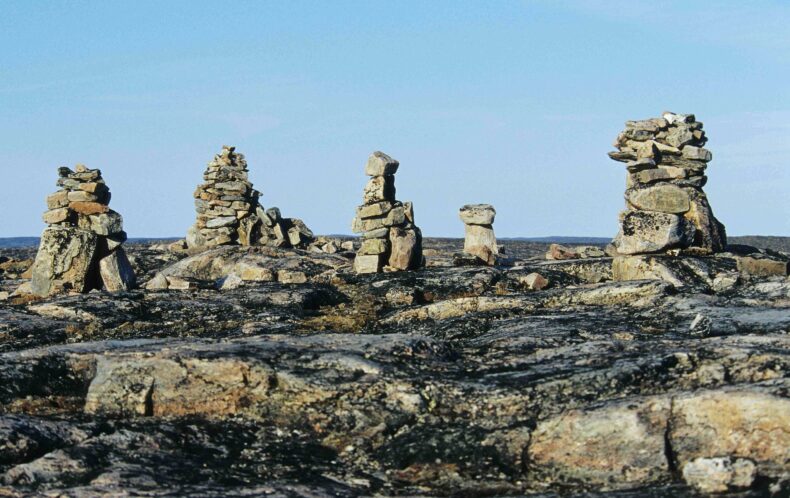
——In the deep past Indigenous hunters learned to take advantage of these caribou qualities in ingenious ways. Because they are punctual, Arctic hunters knew where and when to meet them on the landscape. Because they spook easily and don’t like surprises, hunters developed various kinds of herding structures to influence their movement. Often these were built of stone: rock piles arranged at regular intervals along the landscape, sometimes made to look vaguely like a person with their arms stretched out. In Canada, the Inuit call these figures inuksuit, which means, roughly, things that act in the capacity of a person.
In the caribou’s eyes, the stones were people, and upon spotting them the animals would recoil and veer away. This, of course, was just what the hunters wanted. They used inuksuit to steer caribou toward hunting blinds, or lakes, or other places where they could be more easily killed with lances and arrows. While I’ve encountered ancient inuksuk (the singular form of inuksuit) in my travels through the Arctic, I’ve never met more than one or two at a time. I have seen drawings, though, made by hunters in Alaska, of how they were used long ago. In those renderings, the stone figures, shown in great numbers, look like literal fences—lines drawn across the map. At some point I also realized the lines of inuksuit also looked like a lot like roads.
And I worried about roads, for a while.
On October 6, the Trump Administration resurrected the so-called Ambler Road project. This is a proposed 211-mile long industrial road that will shoot through a currently roadless, uninhabited portion of Arctic Alaskan wilderness, including the southern hem of the Gates of the Arctic National Park and Preserve. Ambler Road will service a mine, or mines, that like the road haven’t been built yet, but Trump seems dead set on getting it done, and he convened a press conference in the Oval Office to talk about it.
In that meeting Trump did what you might expect from a man who views that natural world variously as an ATM or an enemy. He talked about how “America” needs the minerals the mine will provide. He talked about how mining and road building will create jobs and wealth. He did not mention that it will be a private road, meaning the general public will not be able to use it, and that the wealth created will go almost entirely to foreign-owned companies.
He did not mention any of the things that road building usually brings, including pollution of both the physical variety—trash, chemical spills, runoff, and traffic—and less visible (but no less harmful) kinds, such as dust, noise, greenhouse gases, and illegal hunting. He also did not talk about how the road will impact caribou.
If Ambler Road is built, it’ll cut through the home range of the Western Arctic Herd, which is one of the state’s most storied and important herds. The Western, as they’re often called, were formerly Alaska’s largest herd, and at their peak in the early 2000s numbered some half a million animals. But the Western has been in decline for many years, and by 2023, their population had dropped to about 150,000.
This vanishing trend is not limited to the Western. All across the top of the continent migratory caribou populations are falling, some precipitously. And while no one knows why this is happening, two culprits are almost certainly to blame. First is human-caused climate change, which is unraveling the old, relatively reliable world the caribou once knew. The second is human industrial activity, including mining and especially road building.
You probably see by now where my worry was headed.
——
In the late spring of 2022, a biologist in Alaska showed me a digital animation that combined roads and caribou. The caribou, which were wearing satellite tracking collars, appeared as black dots moving across a map. The road—a mining road in the northern part of the state—appeared as a line on the screen. When the black dots hit the line, many, if not most of them, rebounded. Because I am a child of the 80s, I instantly thought of the video game Pong. It was like that: balls bouncing off a paddle.
The biologist had been touring the state, appearing at meetings about the potential effects of the Ambler Road project. At the time, the Biden Administration was mulling the whole thing over, reviewing its permits and purpose. Eventually Biden would kill it, but that hadn’t happened yet and many Alaskas, particularly Indigenous ones who rely on caribou for spiritual well-being as well as physical sustenance, were profoundly concerned about what the road and its attached mine or mines might do to caribou.
The biologist told me he’d show his animation and people in the meetings would sometimes gasp. For the most part, caribou lives unfold far out of our sight. Their challenges, their sufferings and triumphs, lives and deaths, are largely invisible to us, even if we live in caribou country. For many in the audiences, the Pong animation revealed an aspect of caribou-human relations that they had never seen before but recognized right away from their familiarity with the animals, and with old stories about hunting fences.
For a long time mining and oil companies have insisted that their roads, along with their helipads and pipelines and other infrastructure, have hardly any effect on caribou at all. But the satellites were telling a different story. They were showing how human lines scored into earth—not for hunting, but for extraction, for “wealth-generation”—could disrupt caribou movements, possibly throw off their migrations, frighten them into new, unsteady and unreliable behaviors.
“The mine folks didn’t like it much when I showed that animation,” the biologist said.
——
Later, in 2024, he sighed in relief when the Biden Administration scuttled the Ambler Road project. But then Trump resurrected it. Earlier this week I wrote to the biologist to ask how he feels and though I haven’t yet heard back I’m sure I know what he’s going to say. He’s going to tell me he’s worried.
He’ll say what most of us can probably guess: a 211-mile long industrial road, surfaced with gravel and busy with trucks that are feeding the wealth of foreigners will be no friend to the conservative, dwindling caribou of the Western Arctic Herd.
There is still hope that a court might stop the road, or that some other hurdle will block Trump’s plan. No death-cult lasts forever, after all. And if there is a silver lining here for me it may be that I’m not worried anymore. Now I’m angry, and this is good. You can’t do much, I’ve learned, with worry. But anger is, they say, is fuel.